Why Flexion and Balance Belong Together
Most yoga guides treat flexibility and balance as separate goals. They give you a list of forward folds for hamstrings and a separate list of standing poses for stability. But in real life, you don't stretch first and then balance later. You bend down to pick something up, then shift your weight to step over a curb. That combination of spinal flexion (rounding forward) and single-leg stability is what keeps you moving safely.
When I first started practicing, I made the mistake of chasing flexibility alone. I spent ten minutes in seated forward folds, then stood up for Tree Pose and wobbled like a newborn giraffe. My hamstrings were loose, but my hips and core hadn't been trained to stabilize after that lengthening. I learned the hard way that flexibility without immediate stability training can actually increase your risk of falling or straining.
This routine solves that. It's a 10-minute sequence that pairs a gentle forward fold with a standing balance pose, then repeats with variations. You'll build the kind of functional control that makes everyday movements feel easier. And you'll do it in a way that respects your current limits, with wall support options and clear progression.
What You Actually Need to Start
You don't need a fancy mat or expensive gear. A non-slip surface helps, but a towel on a hardwood floor works fine. Wear clothes that let you bend forward without binding at the waist. Bare feet are best for balance awareness.
Keep a chair or a wall within arm's reach. That's your support. Most beginners I've coached worry that using a wall means they're "not doing the pose." That's wrong. Using support is how you build the strength and confidence to eventually balance unsupported. The thing nobody tells you about balance work is that the first 80% of progress comes from learning to engage your standing foot and core, not from lifting your leg higher.
If you have a specific injury - especially a lower back issue or a knee problem - check with your physical therapist before trying flexion poses. Forward folds can aggravate disc issues if done aggressively. The sequence here is gentle, but always listen to your body.
The 10-Minute Flexion + Balance Flow
This sequence has three rounds. Each round starts with a flexion pose (forward fold) to lengthen and release, then immediately transitions into a balance pose to train stability under that new range of motion. You'll hold each balance pose for three to five slow breaths, building up to longer holds over weeks.
I recommend doing this flow in the morning or after a short walk to warm up the muscles. Cold muscles are more prone to strain, especially in forward folds. If you're coming straight from bed, do a few gentle cat-cow stretches first. For a deeper understanding of how to structure a full home practice, see our Beginner's Guide to Easy Home Yoga Flows.
Round 1: Standing Forward Fold (Uttanasana) to Tree Pose (Vrksasana)
Standing Forward Fold (Uttanasana): Stand with feet hip-width apart. Hinge at the hips, not the waist. Keep your knees slightly bent - straight legs are not the goal. Let your head and arms hang heavy. Hold for five breaths. Feel the stretch in your hamstrings and lower back. Most people round their upper back too much here. Instead, imagine lengthening the front of your torso as you fold, like you're draping over a beach ball.
Transition: On an inhale, press through your feet and slowly roll up to standing, leading with your chest. Pause at the top. Shift your weight onto your left foot.
Tree Pose (Vrksasana): Place the sole of your right foot on your left inner thigh, calf, or ankle - never on the knee joint. Bring your hands to your heart or raise them overhead. Find a steady gaze point about four feet in front of you on the floor. Hold for three to five breaths. If you feel yourself wobbling, place one hand on a wall or the back of a chair. That's progress, not failure.
Return: Lower your right foot, then repeat the fold and Tree on the other side.
Round 2: Wide-Legged Forward Fold (Prasarita Padottanasana) to Warrior III (Virabhadrasana III)
Wide-Legged Forward Fold: Step your feet about three to four feet apart, toes pointing forward. Hinge forward from the hips, keeping your spine long. Place your hands on the floor, blocks, or your shins. Hold for five breaths. This pose opens the inner thighs and hamstrings differently than a narrow fold. It also challenges your hip stability - a prerequisite for standing balances.
Transition: Walk your hands back to center, press through your feet, and come up to standing. Bring your feet hip-width apart. Shift your weight onto your left leg.
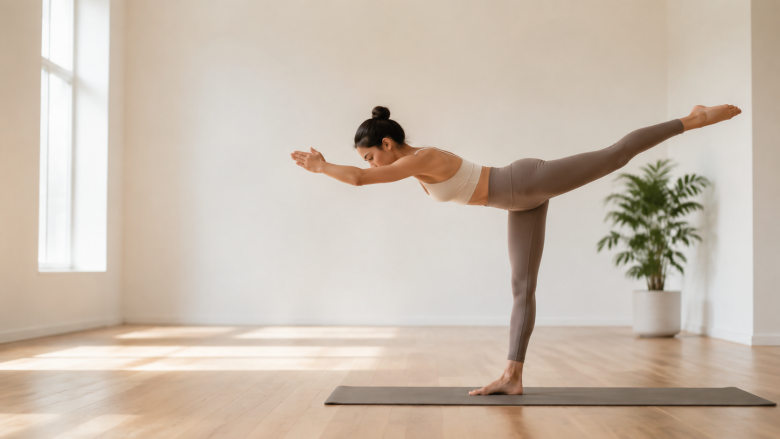
Warrior III (Virabhadrasana III): Hinge forward at the hips, lifting your right leg straight behind you. Keep your standing leg slightly bent if needed. Extend your arms forward or alongside your ears. Your body should form a T shape. Hold for three to five breaths. This is the hardest balance in the sequence. If you can't lift your leg high, that's fine. Focus on keeping your hips square to the floor. A wall support is excellent here: place your fingertips on the wall for light guidance.
Return: Lower your right leg, then repeat the wide fold and Warrior III on the other side.
Round 3: Seated Forward Fold (Paschimottanasana) to Half-Moon Pose (Ardha Chandrasana)
Seated Forward Fold: Sit on the floor with your legs extended in front. Sit on a folded blanket if your hamstrings are tight. Inhale, lengthen your spine. Exhale, hinge forward from the hips, reaching for your shins, ankles, or feet. Hold for five breaths. Don't pull your head toward your knees - that rounds the spine and defeats the purpose. Keep your chest open.
Transition: Come up to a seated position, then stand up. You can use your hands on your thighs for support. Shift your weight onto your left leg.
Half-Moon Pose (Ardha Chandrasana): From a standing position, bend your left knee and place your right hand on the floor or a block about a foot in front of your left foot. Lift your right leg to hip height, and open your hips to the side. Extend your left arm toward the ceiling. This is a lateral balance that also requires hip flexion. Hold for three to five breaths. If you feel unstable, use a wall behind you for your back heel or place your hand on a chair.
Return: Lower your right leg, then repeat the seated fold and Half-Moon on the other side.
How to Progress Over Four Weeks
Do this sequence three times per week, with at least one rest day between sessions. The key is consistency, not intensity. Here's a weekly progression that builds on the same poses without adding complexity.
- Week 1: Hold each balance pose for three breaths. Use wall support whenever needed. Focus on standing foot alignment - press evenly through the base of your big toe, little toe, and heel.
- Week 2: Hold each balance for five breaths. Try to remove one finger from the wall after three breaths, then return to the wall if needed. Aim for a smoother transition between fold and balance.
- Week 3: Hold each balance for eight breaths. Add a dynamic transition: in the fold, sway gently side to side before coming up. This trains your body to find stability after movement.
- Week 4: Hold each balance for ten breaths. Attempt the poses without wall support, but keep the chair nearby. Between rounds, take two slow walking steps to reset your focus.
If you miss a day, don't double up the next day. Just pick up where you left off. The Yoga Streak Calculator can help you track your practice and see how small wins add up over time.
What Type of Yoga Is Best for Balance?
There's no single "best" type. Hatha yoga offers slower standing poses that build balance foundation. Vinyasa adds transitions that challenge stability under fatigue. Iyengar uses props and precise alignment, which is excellent for beginners. But the real answer is that any yoga that includes standing poses on one leg will improve balance, provided you practice it consistently.
What most people don't realize is that balance is skill-specific. Standing on your left leg doesn't automatically improve balance on your right leg. You need to train both sides. And balance gained from yoga doesn't directly transfer to, say, standing on a bus. But it does improve your vestibular system's ability to adapt to shifting surfaces. The routine above works because it pairs a flexibility movement with a balance movement, forcing your nervous system to recalibrate after a change in muscle length.
Common Mistakes and How to Fix Them
Mistake 1: Rushing the forward fold. You want to get into the stretch quickly, so you bounce or yank. That's a recipe for pulled hamstrings. Instead, enter the fold slowly over four breaths. Let gravity do the work.
Mistake 2: Locking the standing knee in balances. A locked knee reduces your ability to adjust micro-movements. Keep a microbend in your standing leg. This engages your quadriceps and calf muscles, which are your balance stabilizers.
Mistake 3: Holding your breath. When you wobble, the natural response is to hold your breath and tighten up. That makes you wobble more. Exhale slowly and soften your gaze. The wobble will decrease.
Mistake 4: Comparing yourself to videos. The person in the tutorial has been practicing for years. Your Tree Pose might look like a wobble with a foot on the opposite ankle. That's fine. The goal is not to look like the picture; the goal is to feel the connection between your foot and the floor.
What to Do When You Feel Stuck
Some weeks you'll feel like you're regressing. Your balance will be worse on a Tuesday than it was on Monday. That's normal. Factors like sleep quality, hydration, stress, and even what you ate for lunch affect your balance. I've had days where I couldn't hold Tree for more than two seconds, and the next day it was fifteen. The thing nobody tells you about balance work is that it's highly variable, and that variability is a sign of a healthy nervous system adapting, not failing.
If you're consistently struggling with a particular pose, try a different entry. For example, instead of lifting your leg directly into Tree, come into a standing forward fold first, then lift your leg behind you into a three-legged dog, then transition to Tree. That sequence often feels more stable because your hamstrings are already engaged.
For a more calming approach that complements this flow, try the Gentle Yoga Routine for Everyday Calm on your rest days.
How This Routine Answers Your Real Questions
You might have searched "What is a good yoga routine for flexibility and balance?" The answer isn't a list of poses - it's a sequence that trains them together, because that's how your body uses them. The routine above is that answer.
You might also ask "What are some good yoga poses for beginners to build flexibility and strength?" The forward folds here build flexibility in the hamstrings, hips, and lower back. The standing balances build strength in the feet, ankles, legs, and core. The combination is more efficient than doing them separately because the balance work challenges the muscles you just stretched, teaching them to support your new range of motion.
And when you wonder "What are some good yoga poses for beginners to improve balance?" you now have a progression: Tree Pose, Warrior III, and Half-Moon. These three are the foundational standing balances. They cover forward, lateral, and rotational stability. If you can hold each for ten breaths on both sides, your balance will be noticeably better in everyday tasks like standing on one leg to put on socks or walking on uneven ground.
When to Modify or Skip a Pose
No pose is mandatory. If any movement causes sharp pain, stop. Dull stretching sensation is okay. Sharp pain is not. Here are specific modifications:
- For tight hamstrings: Keep your knees bent in forward folds. Use blocks under your hands in the wide-legged fold. In seated forward fold, sit on a blanket to tilt your pelvis forward.
- For knee discomfort: Never place the foot directly on the knee in Tree Pose. Use the inner ankle or calf. In Warrior III, keep the standing leg bent more than usual.
- For lower back issues: In forward folds, keep your spine long and only fold as far as you can without rounding. A rounded spine under load can aggravate disc problems. Consider replacing the seated forward fold with a supine hamstring stretch (legs up the wall) and do the balance poses separately.
- For dizziness: If you feel lightheaded when coming up from a fold, keep your head down for an extra breath and use your hands on your thighs to push up slowly. Never rush the transition.
The Real Reason This Works
Flexibility and balance are not separate physical qualities. They are two sides of the same coin. When you lengthen a muscle group, your brain temporarily reduces the tension signals from that muscle. That's why you feel more flexible after a stretch. But if you immediately challenge that muscle group with a balance task, your brain has to reintegrate the new length into your stability map. This process is called sensorimotor adaptation. It's the same mechanism that allows you to learn a new dance step or adjust to a new pair of shoes.
By pairing flexion and balance, you're not just doing two exercises in one session. You're actively training your nervous system to trust your new range of motion under the demands of real-world movement. That's why a structured routine like this is more effective than random pose collections. It's not about doing more; it's about doing the right things in the right order.
Start with week one, use the wall, and be patient with yourself. The results will come faster than you expect - not because the poses are magic, but because you're showing up consistently and intelligently.